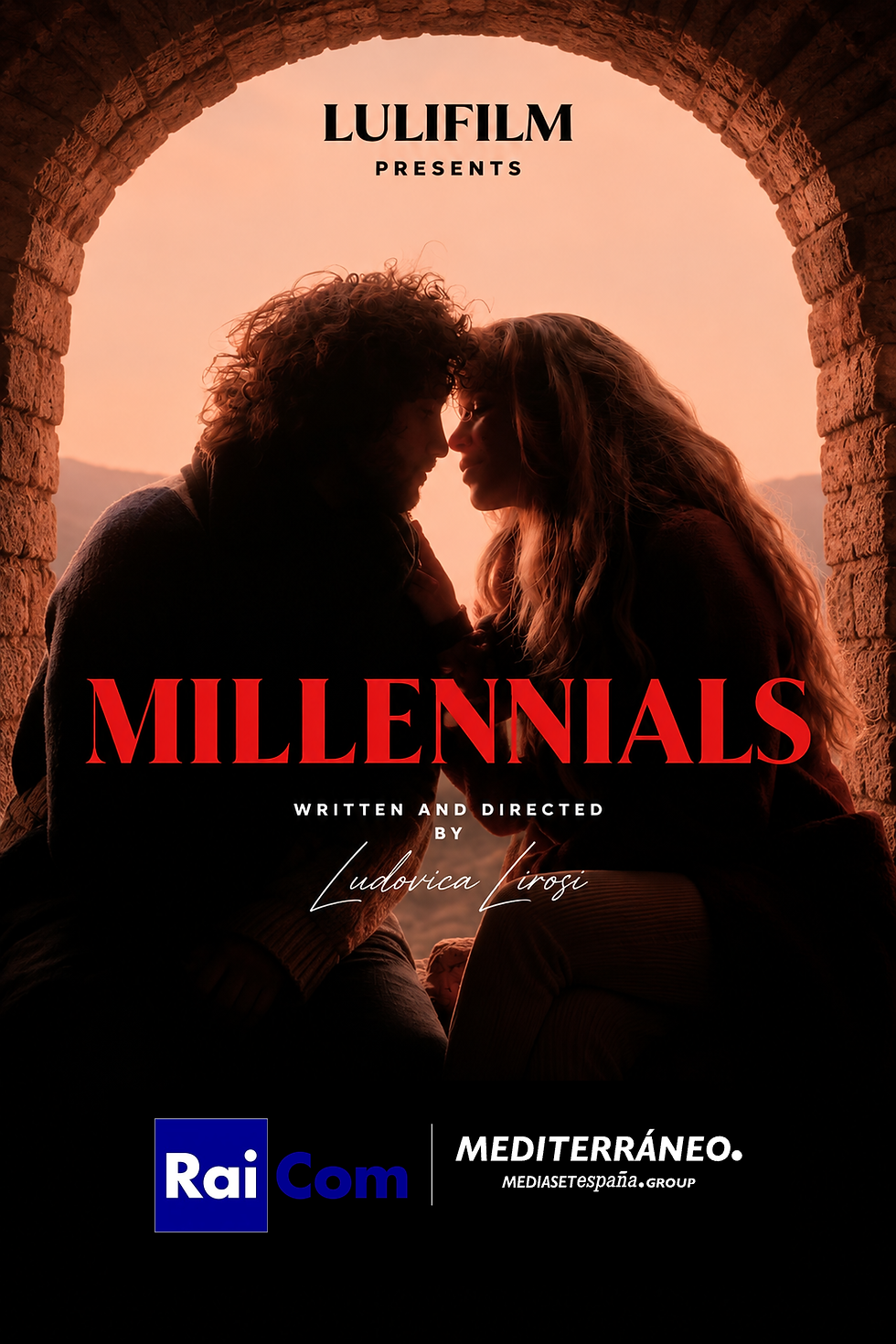
DISTRIBUTION


MILLENNIALS


SHORT SYNOPSIS
MILLENNIALS is a contemporary dramedy that candidly explores the relationships,
vulnerabilities and contradictions of a generation that has reached adulthood while still trying to
find its place in the world. Amid unresolved romances, friendships, sexuality, mental health,
loneliness, family ties and social media, Irene and her friends try to understand who they are and
how much they are willing to sacrifice in order to feel loved. With an ironic yet never superficial
gaze, the series also explores the dynamics of control and manipulation that can gradually seep
into relationships, revealing how difficult they can be to recognize once they become part of
everyday life.
MILLENNIALS is a contemporary dramedy that candidly explores the relationships,
vulnerabilities and contradictions of a generation that has reached adulthood while still trying to
find its place in the world. Amid unresolved romances, friendships, sexuality, mental health,
loneliness, family ties and social media, Irene and her friends try to understand who they are and
how much they are willing to sacrifice in order to feel loved. With an ironic yet never superficial
gaze, the series also explores the dynamics of control and manipulation that can gradually seep
into relationships, revealing how difficult they can be to recognize once they become part of
everyday life. At the heart of the story is Irene, an ironic, instinctive and contradictory singer
trying to relaunch her career while dealing with health issues that often impose limits on her and
a complicated love life. Following the end of her long relationship with Michael, Irene tries to
reclaim her independence, but her bond with her ex continues to resurface through jealousy,
belittling, control and repeated attempts to occupy a space in her life that she no longer wants to
give him. From the earliest episodes, Irene explicitly asserts her right to make her own decisions,
while Michael struggles to accept the separation and continues to challenge her choices.
Meanwhile, new attractions further complicate the picture. Eduardo, her next-door neighbor,
gradually becomes something more than a casual encounter, yet their relationship develops
within an ambiguous space shaped by desire, proclaimed freedom, jealousy and fear of
commitment. Other encounters continually force Irene to question the difference between feeling
free and actually being able to choose freely. Around her moves a true generational ensemble.
Giovanni, her best friend, searches for a relationship capable of moving beyond casual
encounters and, over the course of the season, finds himself confronting people and situations
that challenge the categories through which he has always understood himself and others. In
Episode 9, he articulates one of the series’ central ideas: before finding a label, one must first
understand who one wants to become. Anna and Michele form another of the season’s most
recognizable narrative arcs: what begins as conflict in the digital world develops into a real
relationship. Yet their relationship is constantly shaped by the boundary between public identity
and private life, jealousy, trust and the need to be seen for who they really are. Anna’s social-
media presence and Michele’s personal difficulties prevent their story from becoming a
conventional romantic comedy. Elena moves through unsuccessful dates and new experiences
that lead her to question identity and desire. Lorenzo struggles to accept the end of his long
relationship with Sara and must learn that loving someone can also mean letting them go.
Francesca, more disenchanted and pragmatic, moves through relationships that repeatedly force
her to confront nostalgia, desire and independence. The adult characters are not merely
background figures. Nino, Maria and the various family members bring different generations
into dialogue, reflecting different experiences of stability, work and independence. In Episode 9,
a conversation between Nino and Maria makes one of the series’ generational divides explicit:
for younger people, employment and financial independence can no longer be taken for granted
as automatic milestones of adulthood. Across Rome, apartments, bars, parties, the Lungotevere,
the Tuscan countryside and trips to the sea, MILLENNIALS alternates direct dialogue, everyday
comedy, music and more intimate moments. In several episodes, its predominantly realistic
language opens into dreamlike, musical and choreographed sequences, allowing dreams,
landscapes and movement to become narrative tools.
Page of 3 8Alongside its different romantic storylines, the season gradually develops a darker theme: how difficult it can be to recognize a dysfunctional relationship once control, jealousy and
manipulation have become normalized. The series does not portray this mechanism through one
isolated “event,” but through accumulation: small intrusions into personal boundaries, criticism,
demands, guilt, reconciliations and renewed promises. This progression gives the season finale
its significance. In Tropea, Michael succeeds in presenting himself to their friends as reassuring
and apparently changed, while in private Irene experiences the return of the same dynamics.
Giovanni even begins to reconsider his opinion of Michael, unaware of what Irene is actually
going through. The contrast between public image and private reality therefore pushes one of the
season’s central themes to its extreme. At the same time, Irene’s professional journey continues
to evolve. Music gradually becomes the one space in which she can fully recognize herself: an
encounter with an American producer opens up a new artistic direction, and in Episode 9 she is
offered the opportunity to take part in a major international music event. MILLENNIALS
ultimately portrays a generation that communicates constantly yet often struggles to truly listen;
that claims freedom while continuing to seek belonging; and that must learn to distinguish
between what it desires, what it accepts and what it is no longer willing to tolerate.
SYNOPSIS
TECHNICAL DETAILS
Title: MILLENNIALS
Format: TV Series
Season: 1
Genre: Dramedy, Slice of Life, Young Adult, Relationship-Driven / Romantic
Tone: Contemporary, realistic, direct and ironic, with strong emotional depth and musical
interludes
Setting: Italy — primarily Rome, with storylines developing in Tuscany and Calabria
Episodes: 10 × 30 min
Season Running Time: Approx. 300 min
Primary Audience: 18–35 | Millennials & Gen Z
Original Language: Italian
Year: 2026
Resolution: 4K
Type: TV Series | First-Run
Production: LULIFILM
Distribution: RAI COM and Mediaset Espana Group Mediterraneo
Created, Written and Directed by: Ludovica Lirosi
Original Music: Julia Liros
Songs: Julia Liros
Additional Songs in the Series: Julia Liros, Vincent Arena, Federico Loi, Andrea Buttafuoco,
Andrea Minichilli
Sound Editing & Mix Review: Lorenzo Pontecorvi
MILLENNIALS
CAST — ENGLISH VERSION
SERIES LEAD
IRENE — Julia Liros
Absolute lead and narrative center of the series.
IMDb: https://www.imdb.com/name/nm8356698/
MAIN CHARACTERS / CORE ENSEMBLE
GIOVANNI — Matteo Germinario
Irene’s best friend and confidant.
IMDb: https://www.imdb.com/name/nm17432250/
ANNA — Angelica Pisilli
Irene’s cousin and Lorenzo’s sister; her public and digital identity constitutes one of the central axes of the season.
IMDb: https://www.imdb.com/name/nm17432259/
MICHELE — Derli Do Rosario Soares
Anna’s boyfriend; together with her, he is at the center of one of the series’ main relationship storylines.
IMDb: https://www.imdb.com/name/nm17432254/
LORENZO — Stefano Dichiara
Irene’s cousin and Anna’s brother; he faces the consequences of the end of his relationship with Sara.
IMDb: https://www.imdb.com/name/nm17432267/
MAIN SEASON-ARC CHARACTERS
MICHAEL — Gaetano Marsico
Irene’s longtime ex and the season’s main relational antagonist.
IMDb: https://www.imdb.com/name/nm9349642/
EDUARDO — Yuri Pascale Langer
Irene’s neighbor; a central romantic interest and the main romantic alternative to Michael.
IMDb: https://www.imdb.com/it/name/nm12897663/
ELENA — Beatrice Vignali
Irene’s friend; the protagonist of an important seasonal romantic and identity arc.
IMDb: https://www.imdb.com/name/nm14523627/
MAIN RECURRING CHARACTERS / RECURRING PRINCIPALS
NINO — Luis Molteni
Irene’s “adoptive uncle” and an adult point of reference, providing the series with a different generational perspective.
IMDb: https://www.imdb.com/name/nm0597268/
SARA — Francesca Vannini
Lorenzo’s ex-partner; also important within Elena’s romantic and identity arc.
IMDb: https://www.imdb.com/name/nm9465956/
MARIA — Silvia Rodríguez Pérez
Irene’s aunt and the mother of Anna and Lorenzo; one of the series’ main adult and family figures.
IMDb: https://www.imdb.com/name/nm8366102/
FRANCESCA — Michaela Ciccia
Irene’s sister; independent and pragmatic, she goes through several relationships and romantic choices over the course of the season.
IMDb: https://www.imdb.com/name/nm10627812/
CARMINE — Gianfilippo Chiarello
Giovanni’s recurring dating partner and romantic interest.
IMDb: https://www.imdb.com/name/nm17432264/
SECONDARY RECURRING CHARACTERS / RECURRING SUPPORTING
CARMINE — Gianfilippo Chiarello
Giovanni’s recurring dating partner and romantic interest.
IMDb: https://www.imdb.com/name/nm17432264/
LUCA — Antonio Garofalo
A younger man Irene dates during the early stages of the season.
IMDb: https://www.imdb.com/name/nm12185967/
ENRIQUE — Renato Solustri
Maria’s husband and the father of Anna and Lorenzo.
IMDb: https://www.imdb.com/name/nm15116614/
MICHELE’S MOTHER — Rossella Indraccolo
Michele’s mother; part of the family storyline through which her son’s difficulties emerge.
IMDb: https://www.imdb.com/name/nm14557924/
GIORGIO / MICHELE’S FATHER — Flavio Vedovato
Michele’s father; involved in the family storyline centered on his son’s vulnerabilities.
IMDb: https://www.imdb.com/name/nm16600573/
MARIO — Riccardo Zanatta
Someone Elena dates and part of her romantic journey.
IMDb: https://www.imdb.com/name/nm17432255/
FABRIZIO — Niccolò Vidoni
Michele’s friend and a recurring figure within his social circle.
IMDb: https://www.imdb.com/name/nm10627810/
PSYCHOLOGIST — Eleonora Serafini
A professional figure involved in the family storyline connected to Michele’s difficulties.
IMDb: https://www.imdb.com/name/nm17432256/
VALENTINA — Francesca Maurino
Irene’s friend; later involved in Lorenzo’s storyline.
IMDb: https://www.imdb.com/name/nm17432269/
MINOR RECURRING CHARACTERS / SUPPORTING MINOR
MARCO — Edoardo Mango
Luca’s friend and a supporting character within his arc.
IMDb: https://www.imdb.com/name/nm10879894/
MIRIAM — Julia Charlotte De Rossi
Giovanni’s friend and a recurring presence within his social circle.
IMDb: https://www.imdb.com/name/nm11642210/
STEFANO — Domenico Godano
Francesca’s romantic interest and dating partner.
IMDb: https://www.imdb.com/name/nm17432257/
LUDOVICO — Jacopo D’Amore
Francesca’s romantic interest during a later phase of the season.
IMDb: https://www.imdb.com/name/nm13273326/
GUEST / EPISODIC-ARC CHARACTERS
JOSÉ — Giovanni Napoletani
Eduardo’s friend; a central character in the episodic arc that destabilizes the balance between Irene and Eduardo.
IMDb: https://www.imdb.com/name/nm18819207/
JACK / AMERICAN PRODUCER — Jack Alex Lever
A producer connected to Irene’s professional and musical breakthrough.
IMDb: https://www.imdb.com/name/nm17432268/
BRYAN — Giuseppe Stanzinola
Lorenzo’s friend and a central figure in Irene’s episodic Tuscany arc.
IMDb: https://www.imdb.com/name/nm17432260/
ALBERTO — Alberto Mesiano
Bryan’s friend; he joins the group during the trip to Tuscany and later reappears.
IMDb: https://www.imdb.com/name/nm17432247/
LEONARDO — Alex D’Alascio
A new acquaintance of Giovanni, connected to a personal-discovery arc that continues through Tropea.
IMDb: https://www.imdb.com/name/nm11797112/
LIMA — Francesco Mesiano
A character connected to the music world who takes on a narrative role in the crisis between Anna and Michele.
IMDb: https://www.imdb.com/name/nm17432252/
MINOR / FUNCTIONAL CHARACTERS
FEDERICO / FEDE — Marco Aurelio Carnovale
A figure connected to Bar Federico and the protagonists’ social environment.
IMDb: https://www.imdb.com/name/nm17432249/
PLACIDO — Giacomo Maria Sannibale
Carmine’s partner and a supporting figure within his storyline.
IMDb: https://www.imdb.com/name/nm5735822/
CARLO — Andrea Hegedus
A secondary supporting character.
IMDb: https://www.imdb.com/name/nm10381569/
LINDA — Sabrina Nasti
A secondary supporting character.
IMDb: https://www.imdb.com/name/nm12566733/
ANTONIO — Alessio Romano
A supporting character belonging to the protagonists’ social environment.
IMDb: https://www.imdb.com/name/nm5770572/
VALENTINA’S UNCLE — Mario Castellini
A family figure connected to Valentina’s storyline.
IMDb: https://www.imdb.com/name/nm17432265/
ISABEL — Anfissa Vasileva
A supporting presence credited as Isabel in Episode 3 and Jessica in Episode 4.
IMDb: https://www.imdb.com/name/nm17432261/
CAMEOS / BIT PARTS / CREDITED EXTRAS
RAUL — Andrea Baldini
Brief credited appearance.
IMDb: https://www.imdb.com/name/nm2818461/
GUY 1 — Gianluca Savino
Brief credited appearance.
IMDb: https://www.imdb.com/name/nm17432253/
WAITRESS — Gina Delos Angeles Bulaclac
Brief credited appearance.
IMDb: https://www.imdb.com/name/nm18816056/
GUY 2 — Manuel Iadevaia
Brief credited appearance.
IMDb: https://www.imdb.com/name/nm15539244/
GUY 9 — Vincenzo Cocomero
Brief credited appearance.
IMDb: https://www.imdb.com/name/nm6690463/
PARTY GIRL 1 — Claudia Calselli
Brief credited appearance in the party sequence.
IMDb: https://www.imdb.com/name/nm18824903/
PARTY GIRL 2 — Chiara Barone
Brief credited appearance in the party sequence.
IMDb: https://www.imdb.com/name/nm9749830/
PARTY GIRL 3 — Sveva Betruzzi
Brief credited appearance in the party sequence.
IMDb: https://www.imdb.com/name/nm17432246/
CASHIER — Marcello Forti
Brief credited role in Episode 9.
IMDb: https://www.imdb.com/name/nm18819142/
WAITER 2 — Alessio Tedeschi
Brief credited appearance in Episode 10.
IMDb: -
CREDITED EXTRA — Mohammed Foiz Ullah
Credited non-speaking appearance in Episode 10.
IMDb: https://www.imdb.com/name/nm18819236/
WAITER 4 — Massimo Ciccarelli
Brief credited appearance in Episode 10.
IMDb: https://www.imdb.com/name/nm18819235/Mi


“MILLENNIALS” – TV SERIES: THE REFLECTION OF A GENERATION

THE HEART OF THE SERIES
A generational dramedy that explores, with irony and realism, what happens when freedom,
desire, identity and the need for love collide, revealing from within how control and
manipulation can gradually seep into a relationship until they become difficult to recognize even
for the person experiencing them.
TONE AND EDITORIAL IDENTITY
MILLENNIALS is a contemporary, urban, ensemble-driven generational dramedy built around
the balance between irony, realism and emotional intensity. The series observes its characters
without judging them, allowing them to contradict themselves, make mistakes, desire and change
within relationships that are often difficult to define. Its language is direct, everyday and close to
the spontaneity of real conversation. The comedy arises primarily from the relationships between
the characters, their reactions and the absurdities of contemporary life, while the drama gradually
emerges from the emotional consequences of their choices. Alongside a predominantly realistic
mise-en-scène, some episodes open the narrative into musical, dreamlike and subjective
sequences in which landscape, body, movement and music become part of the storytelling. The
result is a generational story that is accessible without being simplistic, capable of addressing
intimate and social themes without sacrificing lightness, contradiction or the vitality of its
characters.
Page of 4 8AUDIENCE AFFINITIES / COMPARABLE
TITLES
In terms of audience, sensibility and contemporary language, MILLENNIALS can resonate with
viewers of international generational series such as Girls, Valeria, Sex Education and Euphoria.
While sharing with these titles an interest in relationships, identity, sexuality, desire and
contemporary vulnerability, the series creates a broad thematic universe in which romance,
mental health, family, digital identity, loneliness, professional ambition and psychological
dynamics coexist within the same ensemble narrative.
CENTRAL THEMES OF THE SERIES
Gender-Based Violence, Control and Psychological Manipulation.
Rather than focusing only on the overt act, the series explores how these dynamics become
normalized. The Irene–Michael relationship develops through belittling, jealousy, violations of
personal boundaries and an alternating cycle of conflict and reconciliation, culminating in the
contrast between what others perceive and what Irene actually experiences. This psychological
progression allows the series to approach the subject from within rather than through an overtly
didactic representation.
Emotional Freedom and Responsibility.
Irene/Eduardo, Irene/Jose, Sara/Elena/Lorenzo and other storylines repeatedly raise the same
question: declaring oneself free does not mean being immune from the emotional consequences
of one’s choices.
Identity and Self-Definition.
This theme is particularly central to Elena, Giovanni and Leonardo. The season resists the
pressure to assign an immediate label and instead approaches identity as an evolving process.
Digital Identity and Real Identity.
Anna and Michele form the clearest expression of this theme, but it runs throughout the series:
profiles, reputation, social media, published content and carefully constructed online images
continually collide with private vulnerability.
Generational Precarity.
Work, money, independence, housing and the future become almost the generational thesis of
Episode 9. Irene describes herself as simultaneously lacking love, financial stability, employment
and health.
Health and Invisible Vulnerability.
Irene’s health is not simply a narrative obstacle; it becomes part of the distance between how she
appears to others and what she carries with her every day.
Page of 5 8Family and Generational Models.
Parents and older adults are not necessarily more “settled” than the younger characters. They
often project models, expectations and fears onto a generation living under very different
economic, emotional and social conditions.
Artistic Ambition and Reinvention.
Music prevents Irene’s arc from being defined exclusively through the men in her life. It is
essential to her journey: the season’s true positive axis is the construction of a future that belongs
to her.
PRODUCTION
LULIFILM
DISTRIBUTION
• Italy, France & other European/non-European countries: RAI COM
• Spain, Portugal & Latin America: MEDITERRÁNEO (MEDIASET ESPAÑA
GROUP)
• USA LULIFILM


View Gallery
Millennials Created by Ludovica Lirosi